
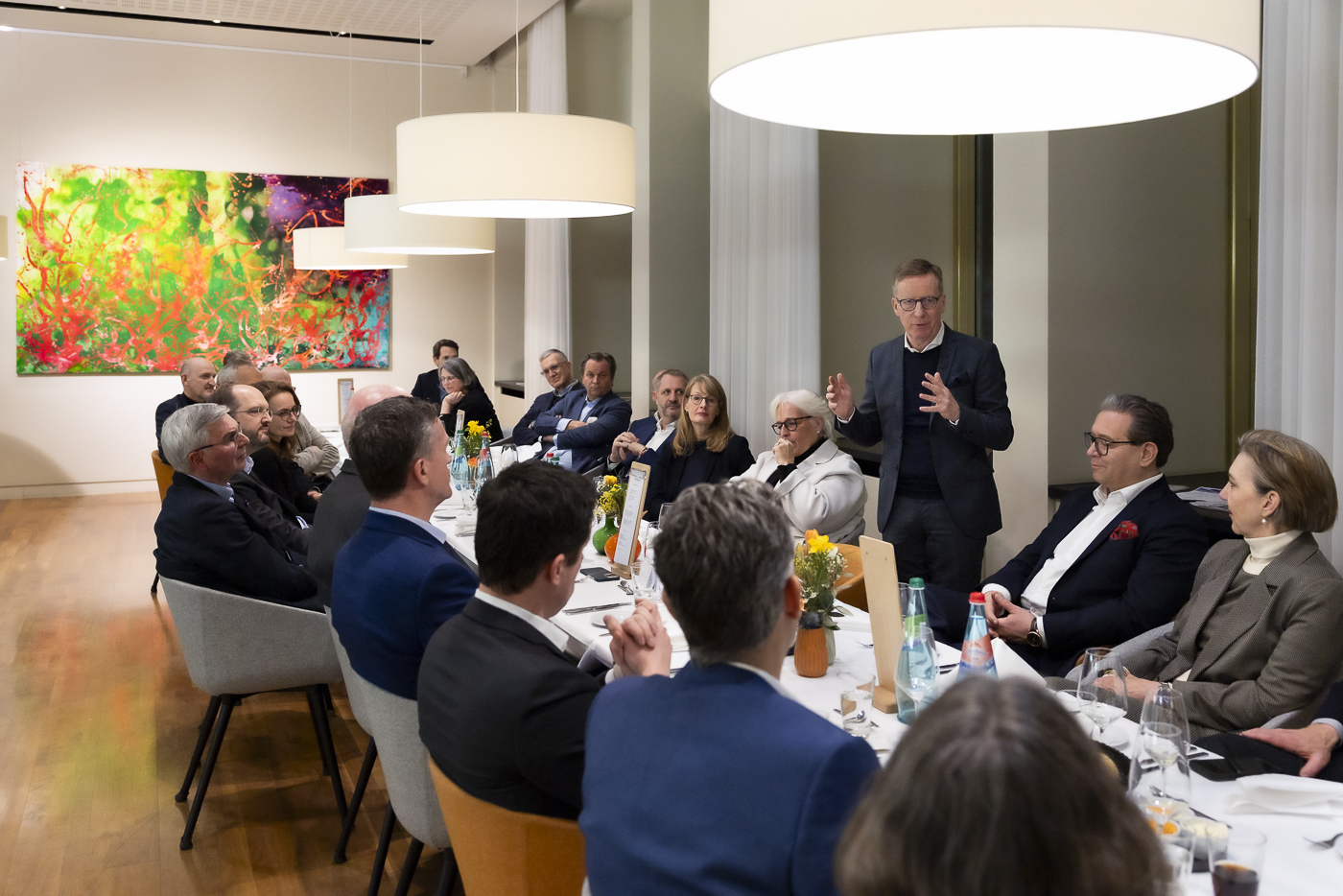
CEOs for Berlin discuss with
Prof. Dr. Michael Hüther
Text Jörg K. Ritter I Coordinator, CEOs for Berlin
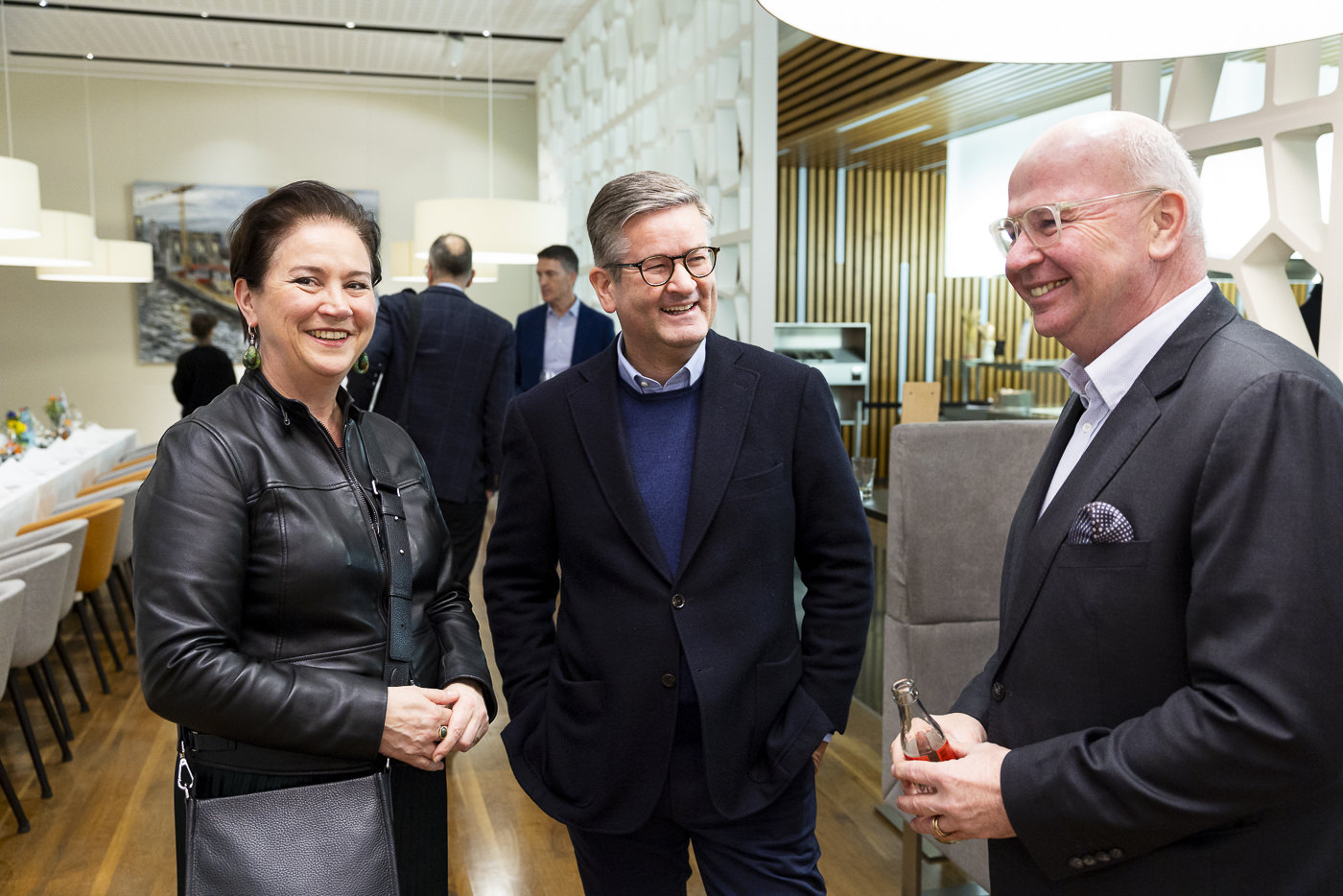
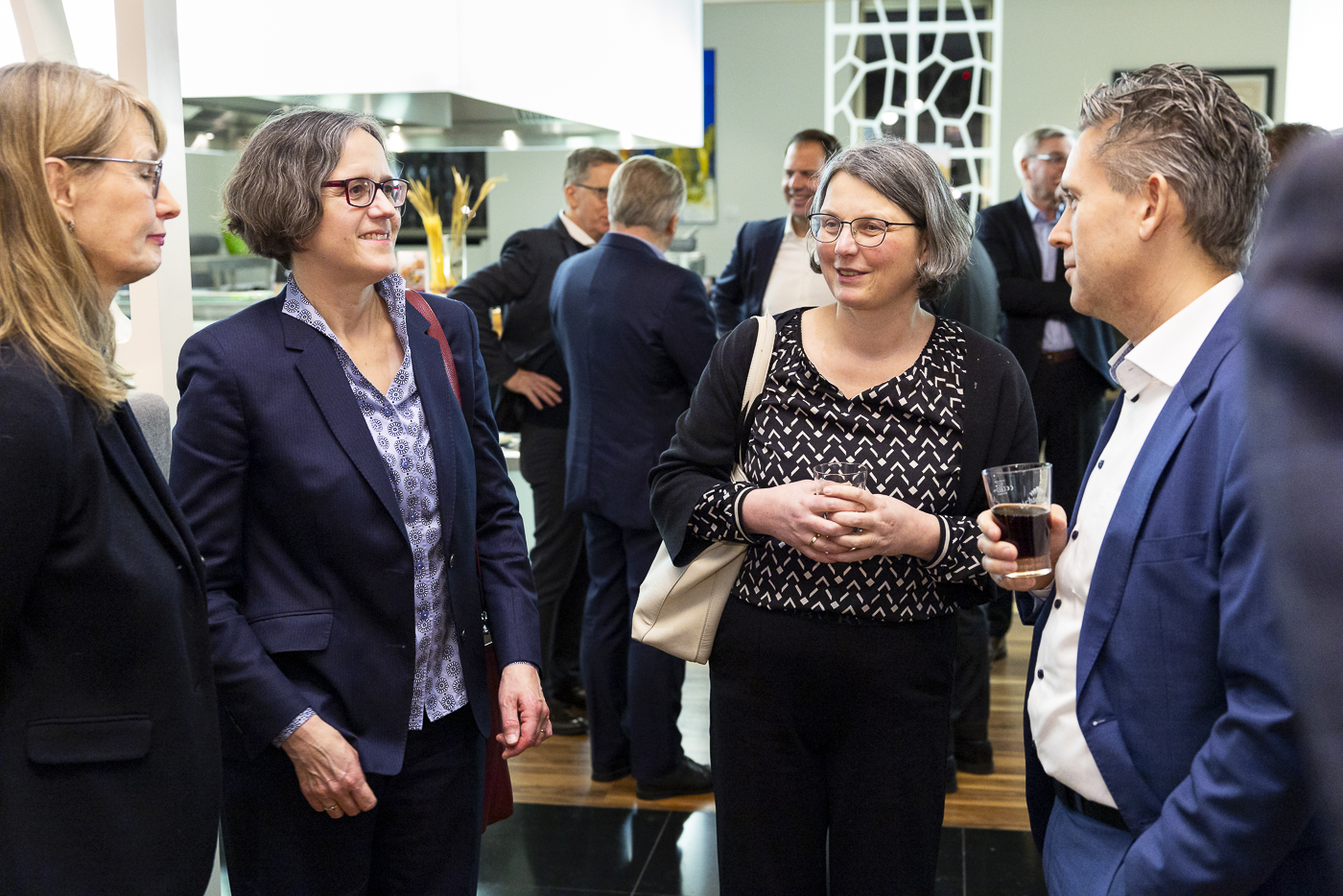
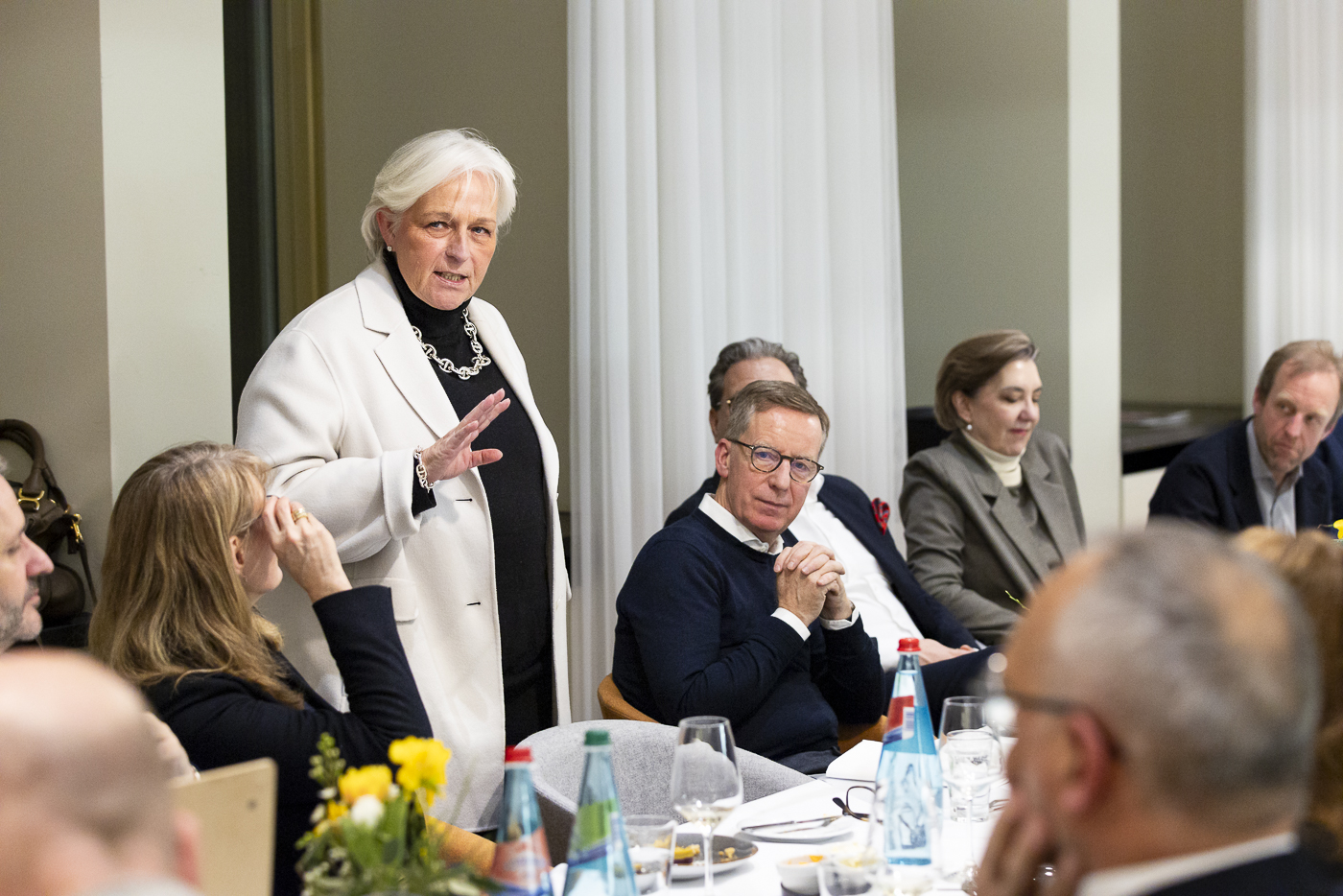
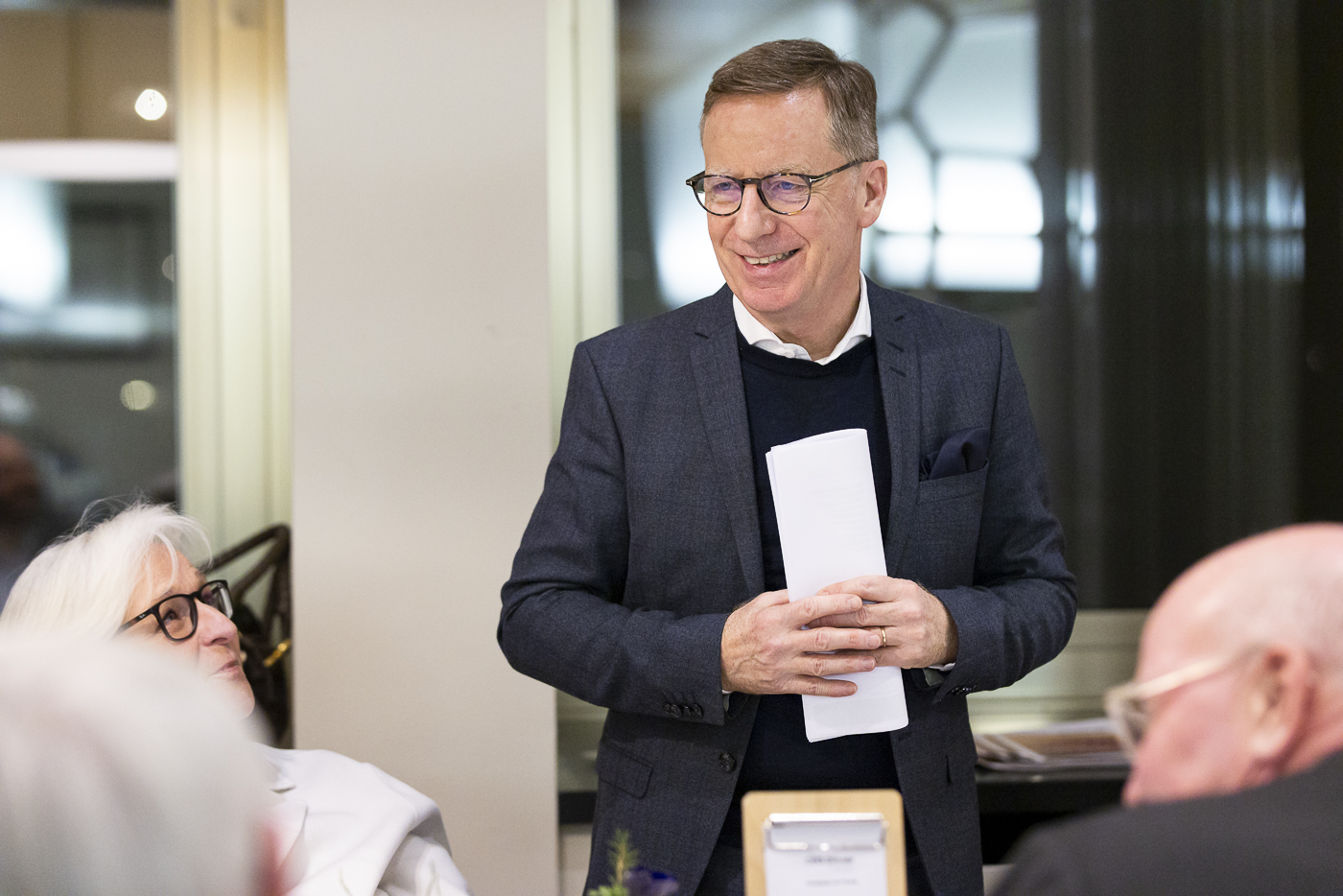
Despite icy roads, 30 CEOs gathered at the ESMT Berlin restaurant on the evening of February 5 to discuss the current state of the German and Berlin economies with Prof. Dr. Michael Hüther, Director of the German Economic Institute (IW).
Right at the start of Michael Hüther's presentation, many were surprised to hear that the federal government had obviously made the right decisions and taken the necessary steps to ensure growth, but that communication errors in particular had led to a different perception among companies and citizens.
In his keynote speech, Hüther focused in particular on the requirements in the areas of labor market, social, and pension policy, as well as on the need to increase the investment and innovation capacity of German and European companies. Although politicians in Berlin and Brussels have correctly identified the necessary prerequisites for this, the implementation of measures such as the urgently needed reduction in energy and labor costs for German companies and the faster activation of investments from the special fund for infrastructure, among other things, has not yet led to sustainable growth in the German economy or to small and medium-sized enterprises, the almost 2,000 hidden and global champions, feeling that they are being taken along on this course.
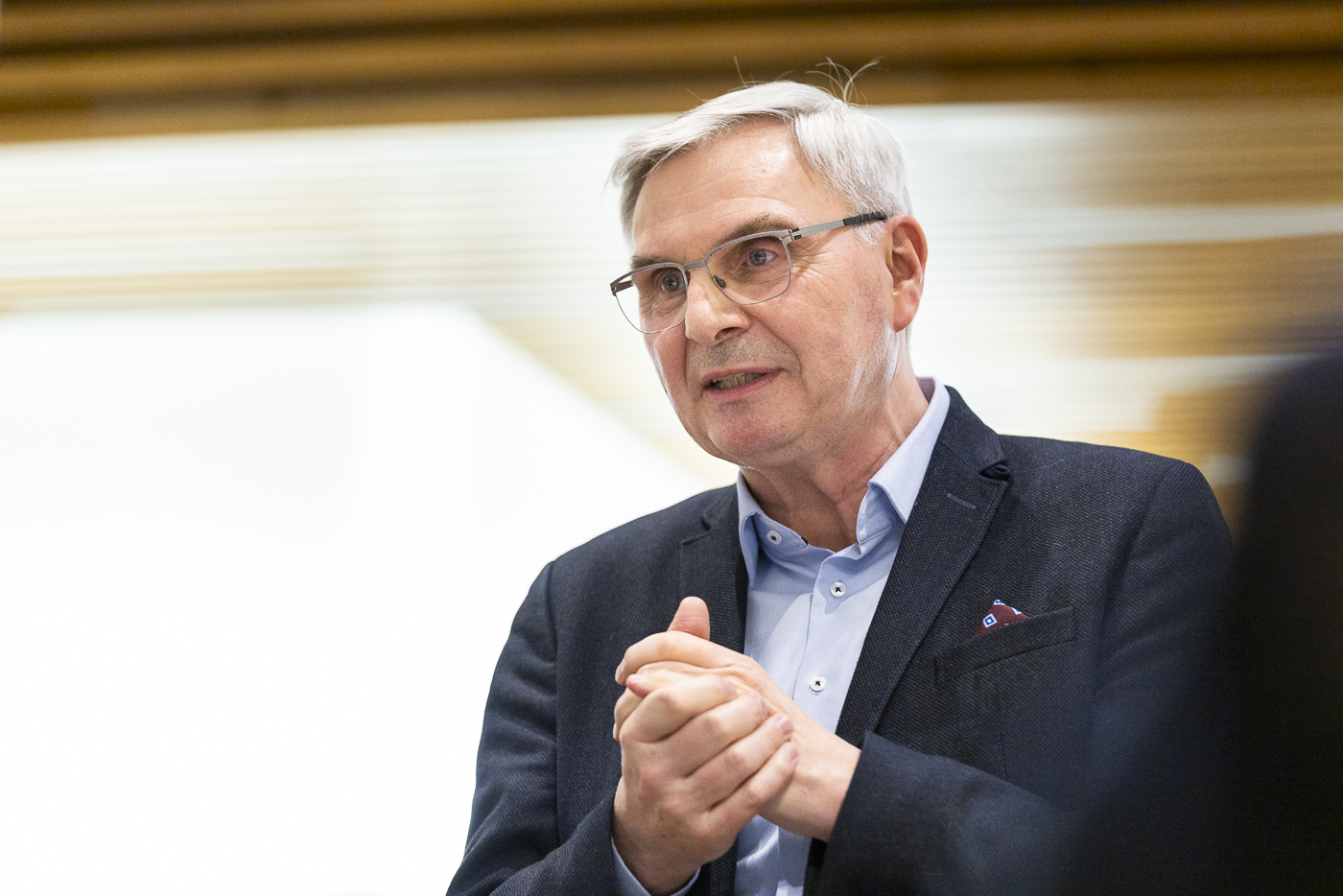
In this context, the IW director contradicted the current debate about "laziness" and "lifestyle." Instead, he identified demographic change as the biggest problem and economic challenge. Few people realize that between 2025 and 2029, around 5.1 million people in Germany will retire, but only 2 million young workers will enter the labor market. This will create a gap of 3.1 million people. This primarily structural gap cannot be solved by the use of AI alone.
He therefore emphasized that there must be a public debate on how we deal with this shortage if we want to continue to define a strong industry as the basis for our prosperity in the future. That is why it is not helpful to constantly tell negative stories. But it is just as wrong to demand completely exaggerated wage demands and working time regulations from the unions, which put companies in Germany in a position where they have to question necessary investments in the future and thus jobs. Instead, solutions need to be discussed, such as how to increase the volume of working hours, for example, how to achieve more full-time work from part-time work and a higher retirement age—linked to life expectancy.
The discussion also focused on the social challenges that could arise from five state elections this year. Hüther referred to a recent study by his institute, which analyzed the AfD's election programs and goals in great detail, concluding that they are based on completely unrealistic economic assumptions and would lead to a further dramatic weakening of the competitiveness of German companies.
Dr. Brigitte Lammers, Senior Advisor at Egon Zehnder, discussed the changing requirements and skills that have become necessary for a CEO to be successful. Participants gained insight into a recent Egon Zehnder study , "The CEO Response – Accepting Uncertainty, CEOs Bet on New Levels of Adaptability," which analyzed the responses of 1,235 global CEOs.
In this context, Egon Zehnder, Strategic Partner of the VBKI Forum CEOs for Berlin, was thanked for making such an annual dinner possible through its sponsorship.
Thanks also went to Dr. Matthias Koch, who, as the new COO & CFO of ESMT Berlin and host of the evening, provided an insight into the impressive achievements of Germany's leading business school. After dinner, Matthias Koch took the guests on a tour of the building, offering exclusive insights into its eventful past.
The European School of Management and Technology Berlin (ESMT) is located in the former State Council building of the GDR in Berlin-Mitte. During the GDR era, this was the seat of the State Council of the GDR. The façade also incorporates Portal IV of the former Berlin Palace, from whose balcony Karl Liebknecht proclaimed the "Free Socialist Republic" in 1918.
Impressions
To the picture gallery: Please click here>
You might also be interested in

"Who are the Marcuses?"
Film screening and talk at the James-Simon-Galerie
Joint declaration
Berlin's business community backs Olympic bid
"Fundraising is a matter for the boss"
Hauptstadtkulturgespräch: Private cultural funding - but how?