
"Justice is not a category in international politics"
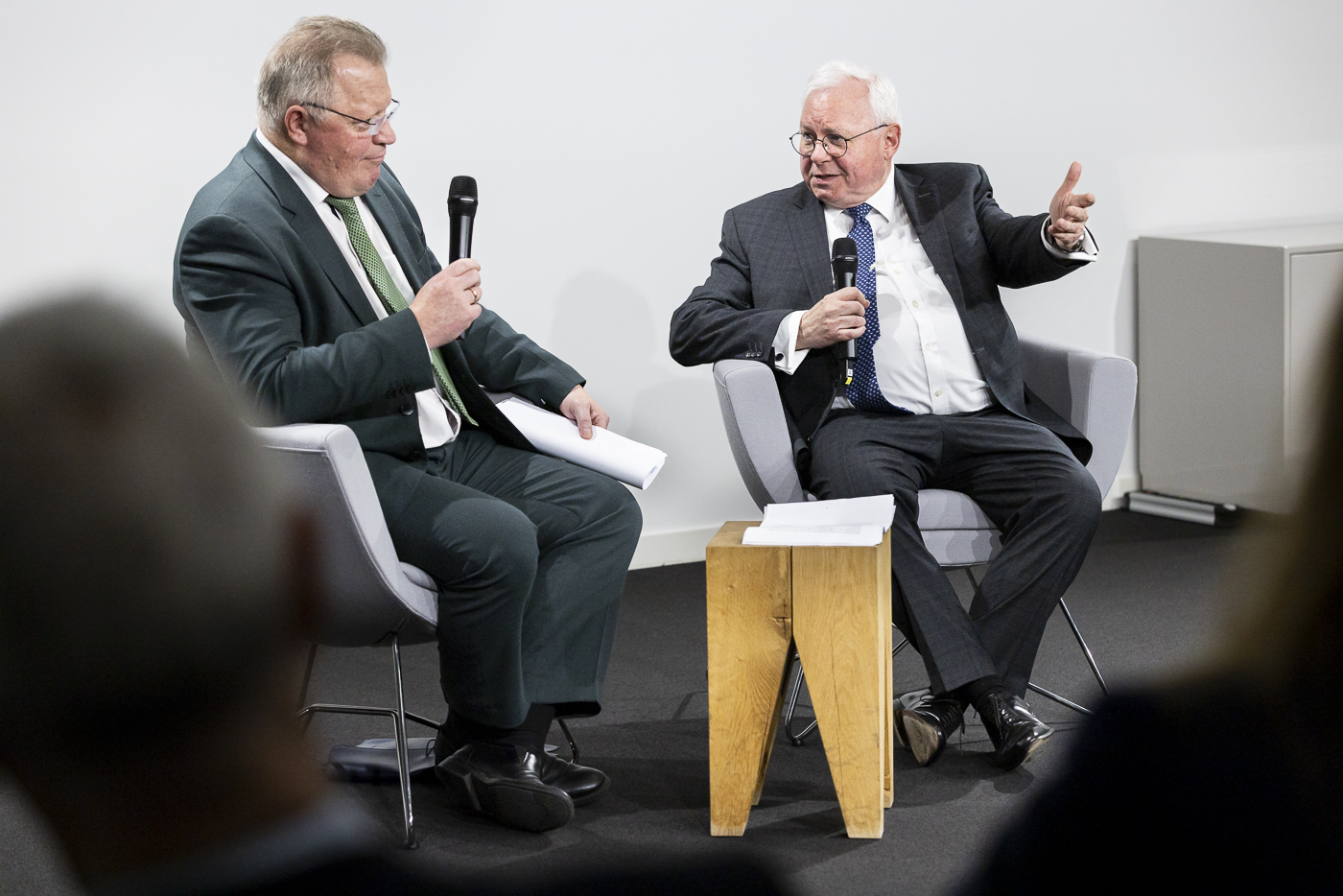
Foreign Policy Lunch with author and former NATO employee Michael Rühle
Text: Philipp Zettl | Policy Officer
Since the inauguration of Donald Trump as US President, events in the Ukraine war have come thick and fast. Determined to negotiate a peace treaty between Ukraine and Russia, the US president is ensnaring Russian President Vladimir Putin and publicly exposing Ukrainian President Volodymyr Zelensky. At the same time, a startled Europe is massively arming itself. Michael Rühle, author and long-time member of NATO's International Staff, tried to look into the future in the Foreign Policy Talk with Co-Chairman Prof. Eberhard Sandschneider. Conclusion: The probability of a shaky peace is high, but relations between the West and Russia will remain poor in the long term.
Both sides must be ready for peace negotiations. And, according to Rühle, it is clear that both Russia and Ukraine are "militarily exhausted". Nevertheless, both sides still see strategic advantages in continuing the war. Russia wants to use the war to maintain its sphere of influence and stop NATO's eastward expansion. Another reason: the Russian Black Sea Fleet was stationed in Crimea on the basis of a long-term lease agreement with Ukraine. However, the possibility of Ukrainian NATO membership increased Russia's concerns that it could lose the strategically important port. According to Rühle, this was reason enough for Russia to "create facts on the ground". For many Ukrainians, on the other hand, the reconquest of the territories occupied by Russia is a prerequisite for a just peace. But "justice has never been a functioning category in international politics," says Rühle. The West, in turn, finds itself in a "paradoxical situation". On the one hand, the Europeans and the USA showed great solidarity by quickly supporting Ukraine in the war and prevented Ukraine from being defeated. On the other hand, the NATO states did not want to support Ukraine too much for fear that a Russia disgraced on the battlefield could act irrationally and unleash a war against NATO.


What could a peace treaty look like in this mixed situation? Michael Rühle has put forward eight theses:
- The new borders are drawn along the current front line, possible territory swaps are postponed
- Western peacekeeping forces are indispensable for securing peace
- The USA will not provide soldiers for the peacekeeping forces, but will support them with reconnaissance work
- The shrunken Ukraine receives security guarantees from the three Western nuclear powers and possibly other states
- Ukraine's accession to NATO is put on the back burner, but EU rapprochement continues
- Ukraine continues to receive Western arms aid
- If the peace process runs relatively smoothly, the sanctions against Russia will gradually be lifted again
- The Ukraine issue and the future European security architecture are dealt with independently of each other
Should things turn out as Rühle predicted, peace would clearly be at Ukraine's expense. But at least, he noted, the then smaller Ukraine could turn further towards the West. And should the USA agree to act as a security guarantor, which he assumes, another Russian invasion would become unlikely.
Will a peace treaty at least lead to a rapid normalization of relations with Russia? No, "relations will remain difficult." Russia will push ahead with the Russification of the annexed territories, making a restoration of pre-war Ukraine increasingly unlikely. And even with security guarantees, Ukraine will continue to feel threatened by Russia. A common basis of trust is also lacking for an improvement in Russian relations with the West as long as Putin continues to destabilize the West. For a serious rapprochement, Russia would have to "close wounds that have been opened - end the hostile measures against the West, admit to Russian war crimes, release the abducted Ukrainian children and much more." A very unlikely prospect under Putin's leadership, says Rühle. It is therefore likely to remain a highly armed coexistence.
Nevertheless, Rühle does not see the less than optimistic prospects of Russia serving as a role model for other heads of state with a desire for war, should Russia ultimately succeed with its land grab: Russia has lost almost 300,000 soldiers in three years and put on a "miserable show". "China will attack Taiwan if it believes that the USA is no longer 100 percent on Taiwan's side, not because Russia is a good role model."
Impressions
To the picture gallery: Please click here>
You might also be interested in
Joint declaration
Berlin's business community backs Olympic bid
Excellence, networking and the courage to change
Healthcare capital Berlin: expert panel discusses paths, hurdles and opportunities
Warsaw - twin city and role model for Berlin
Opinion piece by Kirsten Giering and Johannes von Thadden