
“AI is not an end in itself,
but a tool.”
Digital Webinar: Digital Sovereignty in the Age of AI—Between Efficiency Gains and Dependence
Text by Undine Kugler | Event Management
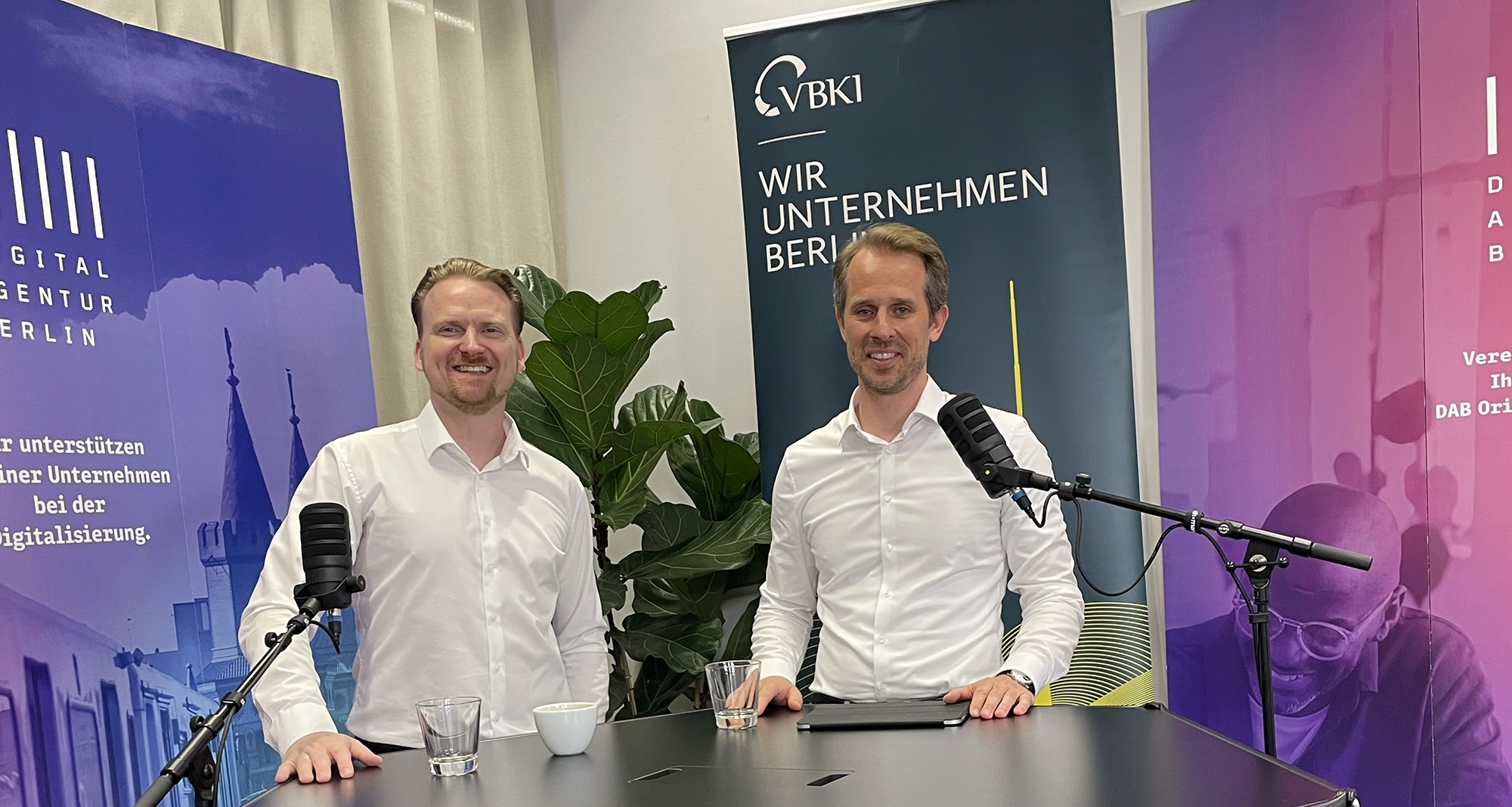
Artificial intelligence is not an end in itself—it is a tool. With this key message, VBKI DIGITAL, in collaboration with the Digitalagentur Berlin (DAB), kicked off a digital webinar on July 7, 2026, exploring how companies can use AI productively without losing sight of their ability to act digitally.
The focus was on the discussion with Julian Kornmaier from empower. He made it clear that artificial intelligence and digital sovereignty go hand in hand. While AI can make companies more efficient and productive, digital sovereignty raises questions about the ability to act, resilience, and strategic independence.
Particularly striking was Kornmaier’s point that AI does not replace knowledge work, but rather reduces, above all, those aspects that do not require genuine expertise. For example, managers, lawyers, doctors, and account managers can be relieved of research, documentation, and preparatory tasks—and gain more time for what people do better: providing guidance, building trust, taking responsibility, and making decisions.
Looking at Germany, it became clear that—given the shortage of skilled workers, demographic change, and stagnant productivity—AI is not a luxury but a competitive imperative. However, it is crucial not to rush into an “AI first” approach. Successful companies do not first ask where AI can be applied, but rather what goal they want to achieve—such as shorter turnaround times, better communication, or more efficient preparation for client meetings.
This led to another important point: Productivity isn’t measured by the initial, impressive demo effect, but by the time it takes to achieve a result that can actually be used. Kornmeier succinctly summarized this approach: Goal before tool, process before prompt, and governance before speed.
Governance, in particular, was described in the webinar as a prerequisite for successful innovation. Clear guidelines provide certainty, prevent “shadow AI,” and help companies share knowledge, limit risks, and empower employees in targeted ways. Governance does not hinder innovation—when properly understood, it is what makes the productive use of AI possible in the first place.
In closing, the focus shifted even more strongly to digital sovereignty. Kornmaier advocated for an understanding of sovereignty that does not aim for isolation but rather for the ability to act. Companies and governments need options; they must assess risks and decide which data, systems, and infrastructures are particularly vulnerable. Not every application requires the same level of sovereignty—what matters is criticality.
The Q&A session, moderated by Steven Lewandowski, a member of the VBKI DIGITAL Committee, addressed topics including the legal framework, European AI alternatives, and related societal issues. The lively discussion highlighted how great the need for guidance remains when it comes to the practical use of AI.
We would like to thank Julian Kornmaier for his insightful and practical analysis, as well as Steven Lewandowski and the Digitalagentur Berlin (DAB) for their collaboration.
You might also be interested in

"Who are the Marcuses?"
Film screening and talk at the James-Simon-Galerie
Joint declaration
Berlin's business community backs Olympic bid

"Fundraising is a matter for the boss"
Hauptstadtkulturgespräch: Private cultural funding - but how?